Thursday, August 21, 2014
Bedroom spaces for older children
I know it has been a very long time since my last post again, and I'm actually cheating today and linking you back to a post on my other blog. It relates to organising personal spaces for older children in a Montessori way. There is always so much written about Montessori for children under the age of 7 at home, however, once they seem to pass into Elementary years, there is less out there.
Much of my learning for this age has been trial and error. I thought you might like to read about how we have finally created a calm and peaceful space for our nearly ten year old.
http://newenglandpondlife.blogspot.co.uk/2014/08/solving-puzzle.html
If you have a bedroom space you'd like to share, please leave a link in the comments below, if you would be kind enough to link my blog to yours then we can create a 'catalogue' of ideas for future Montessori seekers.

Monday, November 11, 2013
Having faith in the child
A friend of mine is a speech therapist and whilst out for dinner the other evening we chatted about when a child's speech may give cause for concern.
Montessori wrote about the sensitive periods of which there are five main ones:
A sensitive period for movement
A sensitive period for small objects
A sensitive period for language
A sensitive period for social aspects
A sensitive period for refinement of the senses
They are all linked to what she called 'The Human Tendencies'. These tendencies are innate and drive us to behave in a particular way. The tendencies are linked to survival and therefore include things like order, movement, exactitude, precision, communication, exploration, socialisation and repetition.
For example: The need for survival means that there is a drive to find food, for this there needs to be exploration. With exploration comes the need to repeat and be precise. Making tools to hunt needs precision and exactitude and then sharing what you have learned with others requires communication. The need to reproduce means man needs to socialise and communicate...as you can see, these inner behaviours are all part of our make up.
Of course, I am not insinuating that we're still on the hunt for woolly mammoths with spears, but our inner drive has not changed.
This therefore means that the sensitive periods that Montessori talks about are naturally occurring, innate and every child will go through them as and when they are ready to do so.
If we have faith in the child that they will require the need to be social as this is an innate desire of man, this will allow us to have faith that a child will pass through the sensitive period for language because they will need language to enable communication, to enable socialisation.
Of course, it is possible for children to pass through these sensitive periods void of stimulus, this will not enable them to repeat or refine their skills. If they are not talked to, then their is less chance that they will be confident and fluent talkers. Looking at other people who wrote about Language development one will soon discover that language development comes from a range of stimuli. Chomsky would say that all children are born with what he called a Language Acquisition Device; in other words, regardless of anything, a child has an innate ability to develop language. However, Bruner and Piaget argued that children needed stimulus and that had to come from the adults around them. I think over the years this has become undisputed. We have seen horrific things on the television in the past about Romanian orphans who have just been left in cots for hours on end without stimulus. The results to my uneducated eye, are conclusively detrimental. Behaviour is irrational and disturbed and language almost non existent, at least in so far as the use of clear words.
So, providing stimulus, talking to the child, giving them the opportunity to listen to stories or rhymes, sing songs or play games that involve language will enable the child to move through the sensitive period for language normally and, just as all children don't walk at the same age because they don't all go through the sensitive period for movement simultaneously, they won't all talk at the same age. Stimulate and trust your child and they will likely develop language when they are ready, however, if you are at all worried, chat with your child's nursery teacher or with your health visitor.
Montessori wrote about the sensitive periods of which there are five main ones:
A sensitive period for movement
A sensitive period for small objects
A sensitive period for language
A sensitive period for social aspects
A sensitive period for refinement of the senses
They are all linked to what she called 'The Human Tendencies'. These tendencies are innate and drive us to behave in a particular way. The tendencies are linked to survival and therefore include things like order, movement, exactitude, precision, communication, exploration, socialisation and repetition.
For example: The need for survival means that there is a drive to find food, for this there needs to be exploration. With exploration comes the need to repeat and be precise. Making tools to hunt needs precision and exactitude and then sharing what you have learned with others requires communication. The need to reproduce means man needs to socialise and communicate...as you can see, these inner behaviours are all part of our make up.
Of course, I am not insinuating that we're still on the hunt for woolly mammoths with spears, but our inner drive has not changed.
This therefore means that the sensitive periods that Montessori talks about are naturally occurring, innate and every child will go through them as and when they are ready to do so.
If we have faith in the child that they will require the need to be social as this is an innate desire of man, this will allow us to have faith that a child will pass through the sensitive period for language because they will need language to enable communication, to enable socialisation.
Of course, it is possible for children to pass through these sensitive periods void of stimulus, this will not enable them to repeat or refine their skills. If they are not talked to, then their is less chance that they will be confident and fluent talkers. Looking at other people who wrote about Language development one will soon discover that language development comes from a range of stimuli. Chomsky would say that all children are born with what he called a Language Acquisition Device; in other words, regardless of anything, a child has an innate ability to develop language. However, Bruner and Piaget argued that children needed stimulus and that had to come from the adults around them. I think over the years this has become undisputed. We have seen horrific things on the television in the past about Romanian orphans who have just been left in cots for hours on end without stimulus. The results to my uneducated eye, are conclusively detrimental. Behaviour is irrational and disturbed and language almost non existent, at least in so far as the use of clear words.
So, providing stimulus, talking to the child, giving them the opportunity to listen to stories or rhymes, sing songs or play games that involve language will enable the child to move through the sensitive period for language normally and, just as all children don't walk at the same age because they don't all go through the sensitive period for movement simultaneously, they won't all talk at the same age. Stimulate and trust your child and they will likely develop language when they are ready, however, if you are at all worried, chat with your child's nursery teacher or with your health visitor.
Education and the teenager
There is a reason to my absence...I've been writing:
I'm in this month's Green Parent Magazine where I'm discussing the benefits of the outside and education for our teens following on Montessori's writings about the Erdkind.
In the UK we seriously lack understanding of how and what our teens need to learn and do during these volatile years. Whilst I am not taking a poke at education or schools, I am saying that there is more to life for our teens than just desks and national curriculum levels and we tend to put a lot of pressure on them at the wrong time. I hope to suggest ways that we can help our teens become rounded and emotionally capable adults and not feel that exams are the be all and end all.
You'll need to cough up the dosh to read the article, which is available in WHSmiths, Boots and some supermarkets as well as healthstores around the country. It's my second article on Montessori education for The Green Parent mag and I have further ones up my sleeve for the future.

I'm in this month's Green Parent Magazine where I'm discussing the benefits of the outside and education for our teens following on Montessori's writings about the Erdkind.
In the UK we seriously lack understanding of how and what our teens need to learn and do during these volatile years. Whilst I am not taking a poke at education or schools, I am saying that there is more to life for our teens than just desks and national curriculum levels and we tend to put a lot of pressure on them at the wrong time. I hope to suggest ways that we can help our teens become rounded and emotionally capable adults and not feel that exams are the be all and end all.
You'll need to cough up the dosh to read the article, which is available in WHSmiths, Boots and some supermarkets as well as healthstores around the country. It's my second article on Montessori education for The Green Parent mag and I have further ones up my sleeve for the future.
Sunday, April 28, 2013
Spontaneous education
Friday lunchtime we had a little girl very upset in the nursery. She was staying for the afternoon session, but she wanted her mum.
Thinking fast on the spot, I asked her if she would like to draw a picture for her mum. She said she did.
We go for a walk on a Friday afternoon and so I then proceeded to find an envelope and explained to her that after she had drawn the picture, we could put it in an envelope, address it and on our walk we would go to the post office to buy a stamp. She decided that she really wanted to do that.
So she drew a lovely picture for her mum and I showed her how to fold it and put it in the envelope.
We took some money on our walk, stopped at the post office where one of the children asked for a stamp. The little girl whose picture it was, posted it in the post box.
To me, this is the exact intention of Montessori education. Real life education.
I'm sure that there are a whole heap of boxes that can be ticked for the EYFS from this activity too, but the main objective of this entire lesson was to cheer up this little girl and this was successful. Further to this, she learned to fold, put a letter in an envelope, she learned that she needed an address and a stamp before posting it in the box. In a few days her mummy will receive her picture through the post so she will begin to understand the cycle.
Friday, October 19, 2012
The coat flip
Oh, ho ho, to be back on UK shores and studying Montessori under a different organisation than AMI...
So, the coat flip.


 For many years, I have taught both my children and friends' children as toddlers to put their coat on using the coat flip:
It was the way I was shown by an AMI trained teacher and it made my children incredibly independent from around the age of 18 months and just look at the face "Look I did it by myself!"
However, within the organisation I am studying they do not believe in the coat flip.
It is not the way that an adult puts on a coat, therefore, as with all Montessori things, we should be demonstrating it in a 'real' sense. They suggest using pairs of children which does beautifully demonstrate grace and courtesy, however, it seriously falls down when you have a single child at home or when you are trying to mould to the "Help me do it by myself" philosophy.
I am not going to argue with the institute. I will, when qualified, help a child to help themselves and use whichever way I feel that particular child may find most beneficial...adding to this, none of my children now do the coat flip but none of them have 'ever' asked me to put their coat on for them!
There is no 'right or wrong' Montessori way, in fact, there seems to be no written word from the great lady herself as to putting a coat on at all. Maybe children in San Lorenzo were too poor to even own a coat, maybe the jacket was worn throughout the day, maybe a small shawl doesn't warrant a coat flip or help from a partner to put on? Either way...you decide
But I just wanted to share with you the 'Jed Bartlett*' way to put on a coat! See...there are 'some' adults who put their coats on this way!
* apologies for the West Wing anoraks out there...Jed, not Jeff!
So, the coat flip.


It was the way I was shown by an AMI trained teacher and it made my children incredibly independent from around the age of 18 months and just look at the face "Look I did it by myself!"
However, within the organisation I am studying they do not believe in the coat flip.
It is not the way that an adult puts on a coat, therefore, as with all Montessori things, we should be demonstrating it in a 'real' sense. They suggest using pairs of children which does beautifully demonstrate grace and courtesy, however, it seriously falls down when you have a single child at home or when you are trying to mould to the "Help me do it by myself" philosophy.
I am not going to argue with the institute. I will, when qualified, help a child to help themselves and use whichever way I feel that particular child may find most beneficial...adding to this, none of my children now do the coat flip but none of them have 'ever' asked me to put their coat on for them!
There is no 'right or wrong' Montessori way, in fact, there seems to be no written word from the great lady herself as to putting a coat on at all. Maybe children in San Lorenzo were too poor to even own a coat, maybe the jacket was worn throughout the day, maybe a small shawl doesn't warrant a coat flip or help from a partner to put on? Either way...you decide
But I just wanted to share with you the 'Jed Bartlett*' way to put on a coat! See...there are 'some' adults who put their coats on this way!
* apologies for the West Wing anoraks out there...Jed, not Jeff!
Friday, September 21, 2012
Montessori furniture
I just have to share some really wonderful links with you today.
These suppliers not only have some great materials you can use in the home or classroom, but many of them are local, sustainable businesses too.

The stool, plank and workbench are calling me at the moment...
 This coat rack is currently on offer at KidsRooms for only £25! They also have table and chair sets for a reasonable price.
Based in the US, but beautifully handcrafted Montessori baby toys!
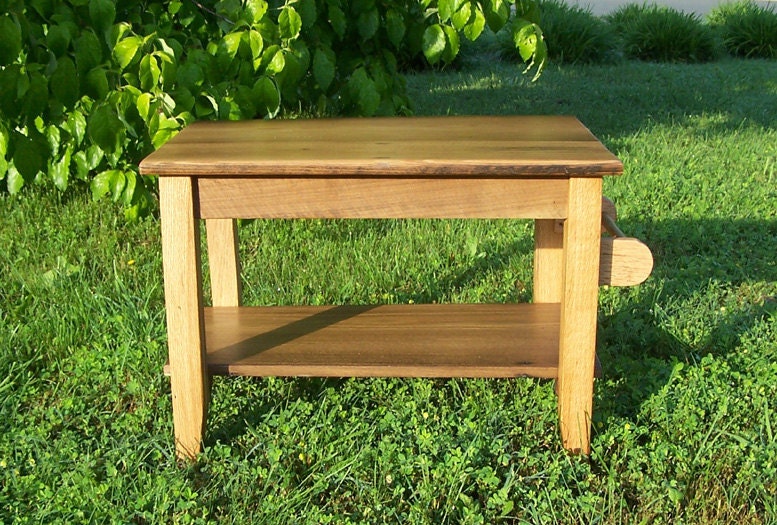
Wow! What do you make of this beautiful handwashing table. Again, sadly in the US. Come on all your British woodcrafters...some of these beautiful tables and useable, small kitchen counters would be fantastic, thank you!
If you know of any beautiful, locally sourced Montessori materials that make the classrooms look so wonderful, please post them, this is the one time only that you can openly advertise yourself if you make proper, traditional Montessori materials IN THE UK. Please don't post your site if you produce PDF documents or sell photocopies of lessons, this is for furniture and equipment.
The third plane
Referring back to my last post about traits of the earlier planes of development recurring once the child moves to a later plane, made me think hard about the behaviours that my eldest (particularly last year) displayed as he moved from 11 - 12years.
Of course, this can't all, by some miracle, be put down to him stepping over that imaginary boundary from childhood into puberty, some of it is also down to a transition from primary school to secondary and with that, a huge amount more homework, responsibility, kit to carry, hours in school etc.
However, the one thing that frustrated me the most until I re read Montessori's philosophy on the four planes of development, was the fact he was so disorganised and forgetful. Particularly when, at two, he would spend hours lining up his cars, at six was methodically working through his work diary to complete the things that needed doing in his school day...
How can you go to school wearing two shoes, and come home with your trainers on but only one shoe in your bag?
How can you forget your homework that you were told to put in your bag straightaway?
How can you forget to take in your swimming kit for the day when you ALWAYS have swimming?
How can you be so tearful about something that seems contrite and in the next minute, you're fine again?
How can you possibly have so many colds?
And how can your eczema be so bad again? It's not been this bad since you were three!
So, I re read what she said about the 12 - 15 age group. How they were prone to mood swings and erratic behaviours, about how they lapsed in concentration and how, she in fact compared this period much like the toddler period of 3 - 6
The toddler becomes engrossed in activities and, if they are not ready to complete the task when asked, there can be quite a tantrum ensuing. They can go to the park with their favourite toy, but easily leave said toy behind on the swing.
Interestingly she states that the period from 12 - 18 is "the period of life in which physical maturity is attained is a delicate and difficult time, because of the rapid development and change which the organism must go through." (From Childhood to Adolescence as cited by Camillo Grazzini in the NAMTA journal Vo.20 no. 1 2004)
She not only means that the child can go through periods of physical illness, but there is likely to spiritual sickness too. It rings true that the teen is more susceptible to glandular fever or meningitis at this time, just like the toddler was at more risk for these illnesses before the age of 5, than any other. Then there being huge hormonal changes that will bring around mental confusion.
So, it is with care and dilligence that my approach toward my newly developing teen is prepared as much as I can, with some reference back to how I would have approached a situation when he was three or four.
If he needed to remember things, I would have continually reminded him, so together we have all made place mats for breakfast time that I've laminated. On these are the lists of all the things they individually need to remember to take with them each day. We are preparing as much as possible the night before. There is still a strong element of structure and order to our home so that they know where things are in order to find them and put them back. They have chores which, I have been giving to them as a lump ie: they need to clean and feed the guinea pigs, dry up, get in the eggs, however, I am realising that it might be easier for them if the jobs were directly allocated so that each child had one area in which to care.
I have also made a concerted effort to give him vitamins each morning to limit the colds and 'maladies' that he gets.
I'm still incredibly fastidious about what goes into his body as I believe that much of their outer personality comes from their inner health (spiritual and physical). He currently keeps a food diary as we are eliminating dairy as a trial period to see whether his eczema improves, it also gives him a good overview as to his mood and sluggishness to see if what he has eaten may have had an effect.
I'm know there is a huge learning curve for all of us, but this is a start.
I know that our schooling system in the UK, does not cater sufficiently for this change in children at secondary school. At a time when they need to grow and sleep, they are on buses at 8am in the morning and working until 8pm at night. At a time when they need to be able to almost go through sensitive periods again, where boys, in particular, need to move to learn; they are put in rows behind desks and taught the same things for the same exams regardless of what they 'want' to learn. I think we have chosen a good school for our eldest. It appears to be nurturing and the pastoral care is outstanding. There are a huge range of activities on offer for them, although emphasis is, naturally, on striving to do the best they can.
There is a good grounding in truth and respect for others. There is a LOT of time spent outside, physical education, gardening and farming (yes, my son's school is getting cows!!! I was thrilled - but sadly they don't offer animal husbandry and horticulture lessons to the parents!) so they are aware of the need to engage in reality. If we can continue to foster his needs at home, he will become a good man.
Of course, this can't all, by some miracle, be put down to him stepping over that imaginary boundary from childhood into puberty, some of it is also down to a transition from primary school to secondary and with that, a huge amount more homework, responsibility, kit to carry, hours in school etc.
However, the one thing that frustrated me the most until I re read Montessori's philosophy on the four planes of development, was the fact he was so disorganised and forgetful. Particularly when, at two, he would spend hours lining up his cars, at six was methodically working through his work diary to complete the things that needed doing in his school day...
How can you go to school wearing two shoes, and come home with your trainers on but only one shoe in your bag?
How can you forget your homework that you were told to put in your bag straightaway?
How can you forget to take in your swimming kit for the day when you ALWAYS have swimming?
How can you be so tearful about something that seems contrite and in the next minute, you're fine again?
How can you possibly have so many colds?
And how can your eczema be so bad again? It's not been this bad since you were three!
So, I re read what she said about the 12 - 15 age group. How they were prone to mood swings and erratic behaviours, about how they lapsed in concentration and how, she in fact compared this period much like the toddler period of 3 - 6
The toddler becomes engrossed in activities and, if they are not ready to complete the task when asked, there can be quite a tantrum ensuing. They can go to the park with their favourite toy, but easily leave said toy behind on the swing.
Interestingly she states that the period from 12 - 18 is "the period of life in which physical maturity is attained is a delicate and difficult time, because of the rapid development and change which the organism must go through." (From Childhood to Adolescence as cited by Camillo Grazzini in the NAMTA journal Vo.20 no. 1 2004)
She not only means that the child can go through periods of physical illness, but there is likely to spiritual sickness too. It rings true that the teen is more susceptible to glandular fever or meningitis at this time, just like the toddler was at more risk for these illnesses before the age of 5, than any other. Then there being huge hormonal changes that will bring around mental confusion.
So, it is with care and dilligence that my approach toward my newly developing teen is prepared as much as I can, with some reference back to how I would have approached a situation when he was three or four.
If he needed to remember things, I would have continually reminded him, so together we have all made place mats for breakfast time that I've laminated. On these are the lists of all the things they individually need to remember to take with them each day. We are preparing as much as possible the night before. There is still a strong element of structure and order to our home so that they know where things are in order to find them and put them back. They have chores which, I have been giving to them as a lump ie: they need to clean and feed the guinea pigs, dry up, get in the eggs, however, I am realising that it might be easier for them if the jobs were directly allocated so that each child had one area in which to care.
I have also made a concerted effort to give him vitamins each morning to limit the colds and 'maladies' that he gets.
I'm still incredibly fastidious about what goes into his body as I believe that much of their outer personality comes from their inner health (spiritual and physical). He currently keeps a food diary as we are eliminating dairy as a trial period to see whether his eczema improves, it also gives him a good overview as to his mood and sluggishness to see if what he has eaten may have had an effect.
I'm know there is a huge learning curve for all of us, but this is a start.
I know that our schooling system in the UK, does not cater sufficiently for this change in children at secondary school. At a time when they need to grow and sleep, they are on buses at 8am in the morning and working until 8pm at night. At a time when they need to be able to almost go through sensitive periods again, where boys, in particular, need to move to learn; they are put in rows behind desks and taught the same things for the same exams regardless of what they 'want' to learn. I think we have chosen a good school for our eldest. It appears to be nurturing and the pastoral care is outstanding. There are a huge range of activities on offer for them, although emphasis is, naturally, on striving to do the best they can.
There is a good grounding in truth and respect for others. There is a LOT of time spent outside, physical education, gardening and farming (yes, my son's school is getting cows!!! I was thrilled - but sadly they don't offer animal husbandry and horticulture lessons to the parents!) so they are aware of the need to engage in reality. If we can continue to foster his needs at home, he will become a good man.
Wednesday, September 12, 2012
"Get out of my Room!"
I haven't blogged about the meaning behind Montessori's Planes of Development yet I know I have wibbled about them from a personal perspective, so I thought it was about time to set the record straight and explain, as best I can, what she meant.



Montessori saw the growth of the child to the flourishment of the man, to be split into four main stages: Stage one, for which many of us in the UK have most recognition, is the time she called 'The Absorbent Mind'.
The Absorbent Mind - Stage one
This period of the child, she explained, was a time whereupon the child is like a sponge. The mind absorbs all that is put around them, hence the title (she was a clever woman ;-)! She also frequently referred to this period as the Embryonic period. Yup, just like we call a developing baby in the womb, an embryo, she wisely saw that the child does so much development and learning outside the womb in those first six years, that they still require the title 'Embryonic'.
She further subdivided this stage into two: The Spiritual embryonic period from ages 0 - 3years and the Social embryonic period from ages 3 - 6 years. I will go into these in more depth on another occasion.
From Stage one, the child moved into Stage Two, referred to as "Childhood" (okay, so she wasn't quite so inventive with the title - got a bit Ronseal!).
Childhood - Stage Two
Childhood sees the child develop from 6 - 12. It's the period in the UK whereupon the child is in primary school, or elementary in the US. The child moves from the concrete to the abstract in reasoning and the period is a time of relative calm within the child.
Stage three is Adolescence and once again, she further subdivides.
Adolescence - Stage Three
The first period of adolescence is 12 - 15 years and she calls this Puberty. It is a period of disquiet once again as the child begins to test boundaries and has a plethora of hormones that can create mood swings and lapses of normal concentration. In fact, she likens this period to the toddler years due to the apparent 'tantrums'. This explains why my 12 year old has come home from school on at least two occasions, without his school shoes!
The second subdivision of this stage is from 15 - 18 years and Montessori called this Adolescence. She noted that the adolescent was impressionable and full of ideas. They may 'attach' to good causes (or what are good causes in their eyes). The drive for independence at this age is as strong as it is at ages 0 - 6.
Most interestingly I discovered, was that she writes that it is an age whereupon children meet most resistance and from that resistance they can gain a flight into fantasy reaction. So it can be a cause of turning to obsessive video game culture or the need to dress like a particular pop star or idol. So where we see children becoming insular or more interested in fantasy than reality and we say 'it's just a teen thing' or 'typical teenagers', maybe it is cause and effect rather than a genetic pre-programming towards video games and unsuitably clothing or behaviours. The environment becomes less prepared for them in a time when it needs to be AS prepared as it was when they were in that first stage.
The more you read about this period, the more fascinating it becomes. The 'Erdkinder' was a product of her desire to provide the correct type of environment for these young people to enable them to feel empowered and unpressurised. The Erdkinder is built on her realisation that a child needs to develop 'life skills' and that these may be best achieved away from the home on a farm or similar. Ironically in the 21st century, this period is when they are are their most vulnerable, feel under most pressure and yet society has chosen this age to be the best age to add to that pressure by creating GCSE and A level exams at the 15 - 18 age! I am going to write another blog post on the Erdkinder at a later date, but for now, feast your eyes on the Hershey school in Ohio!
Stage Four was Maturity from 18 - 24 years.
So; we are moving from a period of relative calm in our house whereupon we have had, for the first time, all three children in the same plane of development and, from an observation perspective, it has been exactly that, relatively calm. The younger one is now able to be sociable with the older two, the older one is able to play with them, or remove himself if he doesn't wish to join in and the middle one is happy there is a sibling either side and doesn't seem to mind which way he goes!
However, we are closing the door on that chapter and already I am beginning to see elements of change. The oldest is now at secondary school in the UK. He is more tearful than he has been. He is more aware of himself and his place within his peer group. He has mentioned his looks on more than one occasion. One of the things we are beginning to feel we need to find boundaries for is the respect for personal space. They have been fairly easy going and tolerant upto now about visitors to their rooms, however, the eldest is at a point where he wants some downtime away from his siblings and, also doesn't want to return home to find he has been visited by a magpie!
So last night we had a small family conference on the top of the stairs after an altercation resulting from this exact problem. I was racking my brains as to how I could deal with this in a positive light and ensure that they were heard and were able to form their own solution to the problem.
I gave them floor space each to put forward this point and from this they needed to democratically decide how to approach this and what the boundaries were for going in and out of each others' rooms.
The result was, for now at least, calm and harmony. Tonight they are going to make each other a door poster that state the 'rules' that need to be observed for privacy.
Independence = Liberty = Discipline at whatever stage of development. I am gradually learning what my 'job' is as an adult of growing boys/girls, how it is not so very dissimilar to having a 3 year old. I still need to set prepare the environment in order for them to carry out the task and achieve independence, in this instant my role was to prepare the forum for them to discuss and to facilitate their plan.
Friday, September 7, 2012
Television for girls
The topic I want to talk about today is television. I know it's quite a hot topic of debate amongst Montessorians and I don't want to extend this into that debate today. The crux of this post is about quality movies for children over six, particularly girls.
I have written before about stories and movies for boys that aren't all about guns and fighting and I will post a list of our choices at the end of the blog for you.
However, girls, strangely enough, are an oddity for me and I realised that I had very little knowledge as to 'girls' movies because my daughter has always chosen to watch the same types of things as her brothers.
The debate as to television viewing per se, is something that in Montessori and, moreso in Steiner, circles goes around as a hushed whisper as if ownership of one is akin to owning a cannabis farm in the garage!
Let's be real though: Montessori, obviously, was not of the era of television, I'm sure she never envisaged a world in which moving pictures would be displayed on a box in the front living room when she wrote her books. However, this IS the 21st century and 'most' families (not all) do have a television and 'most' children have probably watched something on one these days.
I am not going to talk about the pros and cons of television viewing, this post is not about that debate. I will talk about that another day. This post is about the 'quality' of viewing.
From a Montessori perspective, children are unable to extrapolate abstract reasoning, therefore, for a young child to be watching hours of princess fairytales is against the grain of her thinking. Which suggests to me that television before the age of around 3 or 4 is going to be primarily abstract: Teletubbies (do they even exist now?) with overgrown coloured jelly babies and a smiling baby trapped in a sun? Cloud babies? Waybuloo? I'm really not sure that this would be anything other than abstract. I think, true Montessori would be to postpone television at this age and be outside enjoying nature and immersed in reality (I actually think she'd rather see children doing that per se, but we all know that kids like wind down time where they do switch off and they also like to go to the cinema or watch movies with their friends).
However, once that differential has been reached, then what kinds of television watching is there out there that promotes a positive and peaceful image?
I know that my children enjoyed Nina and the Neurons, Storymakers, Ballamory, Big cook, Little cook from CBeebies. We still don't watch CITV for advertising reasons (that'll be another blog post!).
From a movie perspective, I began my parenting by being quite strict with movies. If the movie was first written as a book, I would give my eldest the book to read first. This did work for quite a while due to the fact he was an avid reader at 6, so was able to read Harry Potter and we read the Hobbit with him and Swallows and Amazon, King Arthur and Huck Finn. It meant that when he first saw the movie cover for Harry Potter he was totally disappointed that the images he had in his head of the characters were totally different to the ones portrayed by Alan Rickman and Daniel Radcliffe, so we were able to postpone the viewing of the movie for another couple of years.
However, his brother was not quite the same reader and it was also very difficult to control an eight year old's viewing with his six year old brother around. Hence his brother probably began his Harry Potter enlightenment at a younger age than he.
Their sister, when she began her tv watching was not convinced about Mulan or Pocahontas, she wanted to watch HP as well, so I have never been asked to buy 'Princess' movies or 'Barbie' movies, even the Hannah Montana dvd she was once given for a gift has remained unwatched.
So, to be asked today what movies have a positive image for girls I think my answer would be:
From the age of six onwards:
Harry Potter - Hermione rocks, there are no two ways about that! This movie unequivocally demonstrates you can be clever and cool!!!
However, I would only suggest that the first one were suitable for this age, I would leave number two until the child were a little older. The last ones I feel are quite dark and, I think it depends on the maturity of your girl as to whether you felt she could cope. The thing to remember is that we, as adults, will see things in a whole different way to a child and what we read into something, they will not bat an eyelid at if it is only suggested (acting something out is a whole different thing!)
Despicable Me. Those cute little orphans kick some real butt and it's a great image of being able to change into a nice person, how love wins through in the end and how money isn't the answer to all. Oh and no one dies!
The Lion, Witch and the Wardrobe - again a tale with little Susan being triumphant and strong over her brother, but putting his cruel behaviour toward her out of her mind to save him. It's a tale of trust, love and bravery.
A Series of Unfortunate Events (I'd leave this until around 8 or older as it can be a little dark, but the books are great fun for a confident 7 year old) Violet doesn't let the evil Count win. Another tale of female bravery, sibling unification and some wicked and cunning schemes into the bargain!
Annie - I know, very 70's but my dd absolutely loves Annie. There's nothing better than singing along with her and watching her melt old Daddy Warbuck's heart. Oh and the fact she wins over Rooster adds to the impact!
How to Train Your Dragon was a good one for her. There are some positive female role models in it, but it also has a great underlying theme in believing in who you are and what you can do. She and her brothers also became hooked on the books and her elder brother could speak fluent dragonese from the age of 10 lol!
I guess Monsters Vs Aliens has the female lead and again, there is team spirit and 'not feeling you can't do something because of what you look like' theme (maybe I'm reading a little too deeply into that :-)
For your older child, maybe 8 and up, there is Percy Jackson and the Lightening thief. There is some fighting, but no one dies and it's based on Greek myths which, as my middle child who didn't seem to want to read, read the whole series over and over and won his school's achievement cup for his reading ability and knowledge on The Greeks, I guess isn't a bad thing. There is a female lead in that and she knows how to wield a sword. There is also an underlying theme in this about dyslexia and finding out who you are - maybe this would be overlooked by a child though.
For your much older girl, teenagers, there is Bend it like Beckham. Now, it's been a long time since I watched this, but I seem to recall there was a little bit of swearing, but it is a story of two girls who are football mad and how they overcome their difficulties to follow their dreams. There is cultural and some relationship issues in the film.
Also for teens there is The Sisterhood of the Travelling Pants - which I adore myself as a bit of a feel good chick flick with all the girls coping with a huge variety of every day issue that they manage to get each other through with their deep friendship.
Oh and there's always the Anne of Green Gables series. I have watched the first two movies with my 7 year old (the ones with Meghan Follows in) but the third and fourth that they made just for tv, that is a loose adaptation on LM Montgomery's stories are not suitable. She may enjoy them when she is older, but they are very loose to the books.
Of course, if you can get hold of them, there's always Little House on the Prairie which I remember watching as a girl and wanting to be like Laura. She always knew how to hold her own, had a wonderful loving family and I wanted to be her!
Other television series that my children now enjoy (again from 8 onwards) are Merlin, Dr. Who and we often like to watch things like Frozen Planet, Yellowstone and other documentaries.
I know that this is a very small list and you may have other suggestions. I am particularly keen to hear from those of you that may have suggestions for the 6 - 8 age range for girls. As I said, my dd was never particularly bothered by watching things that were different to her brothers, so I never really did my research into this age group specifically for girls.
I have written before about stories and movies for boys that aren't all about guns and fighting and I will post a list of our choices at the end of the blog for you.
However, girls, strangely enough, are an oddity for me and I realised that I had very little knowledge as to 'girls' movies because my daughter has always chosen to watch the same types of things as her brothers.
The debate as to television viewing per se, is something that in Montessori and, moreso in Steiner, circles goes around as a hushed whisper as if ownership of one is akin to owning a cannabis farm in the garage!
Let's be real though: Montessori, obviously, was not of the era of television, I'm sure she never envisaged a world in which moving pictures would be displayed on a box in the front living room when she wrote her books. However, this IS the 21st century and 'most' families (not all) do have a television and 'most' children have probably watched something on one these days.
I am not going to talk about the pros and cons of television viewing, this post is not about that debate. I will talk about that another day. This post is about the 'quality' of viewing.
From a Montessori perspective, children are unable to extrapolate abstract reasoning, therefore, for a young child to be watching hours of princess fairytales is against the grain of her thinking. Which suggests to me that television before the age of around 3 or 4 is going to be primarily abstract: Teletubbies (do they even exist now?) with overgrown coloured jelly babies and a smiling baby trapped in a sun? Cloud babies? Waybuloo? I'm really not sure that this would be anything other than abstract. I think, true Montessori would be to postpone television at this age and be outside enjoying nature and immersed in reality (I actually think she'd rather see children doing that per se, but we all know that kids like wind down time where they do switch off and they also like to go to the cinema or watch movies with their friends).
However, once that differential has been reached, then what kinds of television watching is there out there that promotes a positive and peaceful image?
I know that my children enjoyed Nina and the Neurons, Storymakers, Ballamory, Big cook, Little cook from CBeebies. We still don't watch CITV for advertising reasons (that'll be another blog post!).
From a movie perspective, I began my parenting by being quite strict with movies. If the movie was first written as a book, I would give my eldest the book to read first. This did work for quite a while due to the fact he was an avid reader at 6, so was able to read Harry Potter and we read the Hobbit with him and Swallows and Amazon, King Arthur and Huck Finn. It meant that when he first saw the movie cover for Harry Potter he was totally disappointed that the images he had in his head of the characters were totally different to the ones portrayed by Alan Rickman and Daniel Radcliffe, so we were able to postpone the viewing of the movie for another couple of years.
However, his brother was not quite the same reader and it was also very difficult to control an eight year old's viewing with his six year old brother around. Hence his brother probably began his Harry Potter enlightenment at a younger age than he.
Their sister, when she began her tv watching was not convinced about Mulan or Pocahontas, she wanted to watch HP as well, so I have never been asked to buy 'Princess' movies or 'Barbie' movies, even the Hannah Montana dvd she was once given for a gift has remained unwatched.
So, to be asked today what movies have a positive image for girls I think my answer would be:
From the age of six onwards:
Harry Potter - Hermione rocks, there are no two ways about that! This movie unequivocally demonstrates you can be clever and cool!!!
However, I would only suggest that the first one were suitable for this age, I would leave number two until the child were a little older. The last ones I feel are quite dark and, I think it depends on the maturity of your girl as to whether you felt she could cope. The thing to remember is that we, as adults, will see things in a whole different way to a child and what we read into something, they will not bat an eyelid at if it is only suggested (acting something out is a whole different thing!)
Despicable Me. Those cute little orphans kick some real butt and it's a great image of being able to change into a nice person, how love wins through in the end and how money isn't the answer to all. Oh and no one dies!
The Lion, Witch and the Wardrobe - again a tale with little Susan being triumphant and strong over her brother, but putting his cruel behaviour toward her out of her mind to save him. It's a tale of trust, love and bravery.
A Series of Unfortunate Events (I'd leave this until around 8 or older as it can be a little dark, but the books are great fun for a confident 7 year old) Violet doesn't let the evil Count win. Another tale of female bravery, sibling unification and some wicked and cunning schemes into the bargain!
Annie - I know, very 70's but my dd absolutely loves Annie. There's nothing better than singing along with her and watching her melt old Daddy Warbuck's heart. Oh and the fact she wins over Rooster adds to the impact!
How to Train Your Dragon was a good one for her. There are some positive female role models in it, but it also has a great underlying theme in believing in who you are and what you can do. She and her brothers also became hooked on the books and her elder brother could speak fluent dragonese from the age of 10 lol!
I guess Monsters Vs Aliens has the female lead and again, there is team spirit and 'not feeling you can't do something because of what you look like' theme (maybe I'm reading a little too deeply into that :-)
For your older child, maybe 8 and up, there is Percy Jackson and the Lightening thief. There is some fighting, but no one dies and it's based on Greek myths which, as my middle child who didn't seem to want to read, read the whole series over and over and won his school's achievement cup for his reading ability and knowledge on The Greeks, I guess isn't a bad thing. There is a female lead in that and she knows how to wield a sword. There is also an underlying theme in this about dyslexia and finding out who you are - maybe this would be overlooked by a child though.
For your much older girl, teenagers, there is Bend it like Beckham. Now, it's been a long time since I watched this, but I seem to recall there was a little bit of swearing, but it is a story of two girls who are football mad and how they overcome their difficulties to follow their dreams. There is cultural and some relationship issues in the film.
Also for teens there is The Sisterhood of the Travelling Pants - which I adore myself as a bit of a feel good chick flick with all the girls coping with a huge variety of every day issue that they manage to get each other through with their deep friendship.
Oh and there's always the Anne of Green Gables series. I have watched the first two movies with my 7 year old (the ones with Meghan Follows in) but the third and fourth that they made just for tv, that is a loose adaptation on LM Montgomery's stories are not suitable. She may enjoy them when she is older, but they are very loose to the books.
Of course, if you can get hold of them, there's always Little House on the Prairie which I remember watching as a girl and wanting to be like Laura. She always knew how to hold her own, had a wonderful loving family and I wanted to be her!
Other television series that my children now enjoy (again from 8 onwards) are Merlin, Dr. Who and we often like to watch things like Frozen Planet, Yellowstone and other documentaries.
I know that this is a very small list and you may have other suggestions. I am particularly keen to hear from those of you that may have suggestions for the 6 - 8 age range for girls. As I said, my dd was never particularly bothered by watching things that were different to her brothers, so I never really did my research into this age group specifically for girls.
Thursday, August 23, 2012
Monkey see, monkey do
Today I witnessed something that has weighed heavily on my heart.
A heavily pregnant mother was in the supermarket with her two children, both under 5 I would guess.
The younger one, was getting tired and wanting to be picked up, however, she had her shopping trolley and the hand of the other one too.
I was not able to help her, only observe from some distance as I was in the queue.
However, I was able to hear the protestations of the younger one which were getting gradually louder.
But, it wasn't this that made me turn my head as the sounds of cries of tired and bored toddlers are common in a large supermarket in the middle of the day.
What did make me turn and look was a sudden 'SHUSH' with a ferocity that made me think 'Wow! he's cross with his child!'
But no! He was not cross with HIS child, he was in the face of the pregnant woman's child!
'I come to do my shopping' he growled for us all to hear, 'not listen to a child crying'.
It is sad that he felt it necessary to criticise a mother who was probably tired herself, rather than offer a hand of friendship or help.
So why am I writing this here?
Because from this incident, this child has learned nothing about the world bar intolerance. When he turns around to his new sibling and yells at it to be quiet, he will be reprimanded, yet he is just mirroring the behaviour he himself experienced.
When we observe the child and the child's behaviour it is important to recall our own behaviours. What we are seeing is learned behaviour and will reflect what the child sees.
The child is born as a blank canvas, it is not born knowing how to 'push buttons' or 'misbehave'. What we may construe as inappropriate behaviour is learned, either by observations of the child's own from his/her care giver, or by the need to find way to receive attention when it needs help or assistance.
 When the child cries, it is not to annoy or wind up, it is because it has not yet developed the capacity for speech or explanation. Helping the child to help themselves will lessen the tears, respecting times for sleep and appreciating the need for times to burn off energies will reduce tantrums or melt downs.
"It's amazing how we teach our children what we ourselves need to learn. We yearn for them to understand what we never did, to be the perfect, balanced people we always wanted to be. Yet our feelings are often contradictory. We want them to have it all, but not be greedy. We want them to be giving, but not to give it all away. We want them to have everything they want, but always to share..."
- Rabbi Irwin Kula
I feel this quotation beautifully explains how, as adults, we can be so hypocritical with our children. We want them to listen to us, but do we really listen to them? We want them to be kind to others, but are we being kind to them when we shout at them because we're tired? We want them to be orderly, but are we being orderly when we leave the washing up or fling our shoes in a corner? When we utter an annoyance with a cursive thrown in, are we really that surprised when the child is heard saying the same word to his toys or friend?

It is hard to parent. It is hard to laugh when you are tired, it is hard to tickle when you want to smack, it is hard to respond calmly when you have responded three times already that night, it is hard to be fully present when you have an agenda to organise for tomorrow's meeting, it is hard to take time to prepare, sit and eat together when you have activities to run children to... but in order to have a tolerant society, we need to start with our children.

A heavily pregnant mother was in the supermarket with her two children, both under 5 I would guess.
The younger one, was getting tired and wanting to be picked up, however, she had her shopping trolley and the hand of the other one too.
I was not able to help her, only observe from some distance as I was in the queue.
However, I was able to hear the protestations of the younger one which were getting gradually louder.
But, it wasn't this that made me turn my head as the sounds of cries of tired and bored toddlers are common in a large supermarket in the middle of the day.
What did make me turn and look was a sudden 'SHUSH' with a ferocity that made me think 'Wow! he's cross with his child!'
But no! He was not cross with HIS child, he was in the face of the pregnant woman's child!
'I come to do my shopping' he growled for us all to hear, 'not listen to a child crying'.
It is sad that he felt it necessary to criticise a mother who was probably tired herself, rather than offer a hand of friendship or help.
So why am I writing this here?
Because from this incident, this child has learned nothing about the world bar intolerance. When he turns around to his new sibling and yells at it to be quiet, he will be reprimanded, yet he is just mirroring the behaviour he himself experienced.
When we observe the child and the child's behaviour it is important to recall our own behaviours. What we are seeing is learned behaviour and will reflect what the child sees.
The child is born as a blank canvas, it is not born knowing how to 'push buttons' or 'misbehave'. What we may construe as inappropriate behaviour is learned, either by observations of the child's own from his/her care giver, or by the need to find way to receive attention when it needs help or assistance.
 When the child cries, it is not to annoy or wind up, it is because it has not yet developed the capacity for speech or explanation. Helping the child to help themselves will lessen the tears, respecting times for sleep and appreciating the need for times to burn off energies will reduce tantrums or melt downs.
"It's amazing how we teach our children what we ourselves need to learn. We yearn for them to understand what we never did, to be the perfect, balanced people we always wanted to be. Yet our feelings are often contradictory. We want them to have it all, but not be greedy. We want them to be giving, but not to give it all away. We want them to have everything they want, but always to share..."
- Rabbi Irwin Kula
I feel this quotation beautifully explains how, as adults, we can be so hypocritical with our children. We want them to listen to us, but do we really listen to them? We want them to be kind to others, but are we being kind to them when we shout at them because we're tired? We want them to be orderly, but are we being orderly when we leave the washing up or fling our shoes in a corner? When we utter an annoyance with a cursive thrown in, are we really that surprised when the child is heard saying the same word to his toys or friend?
It is hard to parent. It is hard to laugh when you are tired, it is hard to tickle when you want to smack, it is hard to respond calmly when you have responded three times already that night, it is hard to be fully present when you have an agenda to organise for tomorrow's meeting, it is hard to take time to prepare, sit and eat together when you have activities to run children to... but in order to have a tolerant society, we need to start with our children.

Wednesday, August 22, 2012
Folding
Gosh so much has happened again since I last posted, but, this blog is not about my life, but about Montessori, so as I am returning to the classroom via a Montessori diploma and am starting some Montessori inspired parent and infant classes, I'm going to get right back on top of blogging some great Montessori thoughts, tips and ideas for bringing Montessori right into the home.
My children are getting so much older now and the beautiful Montessori quotation
could be seen to be less appropriate now, but how wrong that would be.
As with all things, we parents are always the directors, the guiders if you like, not the teachers, the children teach themselves and at any age that is true. My role now as they get older is to listen to their choices, suggest my thoughts but to not do it for them or inflict my ideas upon them. Of course, I can reflect on their choices and give them my reflections, but I hope (in the truest Montessori way) that they will be independent enough to come to their own well thought through decisions. That is the goal we are all striving for right...although, on days when they all fight and bicker, I do wonder whether we will get there!
However, today I want to share with you a really simple piece of equipment that can help them to fold things, it can start as simply as with a tea towel, but eventually you can show them how to fold a simple t shirt.
First you need a few squares of plain fabric. It has to be plain as any patterns will detract from the activity.
I hemmed around the edges and then you can make different fold lines on them by sewing in a coloured thread.

Then show the child how to match the edges so that you are folding on the coloured line.

Squares


Triangles
You can then do ones with several folds.
If you have an older child, you might even consider using this activity to introduce them to a cool iron and ironing board. We did this today and at 7, she was more than capable. My feeling is that as long as you can have them (the child) standing with both feet on the floor rather than on a stool, so they can reach the board (mine goes to a really low height) you can show them how to iron.

I just had to show you this as well. This is a child sized cheese or lemon/nutmeg grater. It's amazing what you can find when you look around. Thank you TKMaax!
Over the next few months as I begin to prepare for the Parent and Infant classes and my own Montessori journey I will bring you more reflections and share further ideas.
My children are getting so much older now and the beautiful Montessori quotation
"Help me to do it by myself"
As with all things, we parents are always the directors, the guiders if you like, not the teachers, the children teach themselves and at any age that is true. My role now as they get older is to listen to their choices, suggest my thoughts but to not do it for them or inflict my ideas upon them. Of course, I can reflect on their choices and give them my reflections, but I hope (in the truest Montessori way) that they will be independent enough to come to their own well thought through decisions. That is the goal we are all striving for right...although, on days when they all fight and bicker, I do wonder whether we will get there!
However, today I want to share with you a really simple piece of equipment that can help them to fold things, it can start as simply as with a tea towel, but eventually you can show them how to fold a simple t shirt.
First you need a few squares of plain fabric. It has to be plain as any patterns will detract from the activity.
I hemmed around the edges and then you can make different fold lines on them by sewing in a coloured thread.
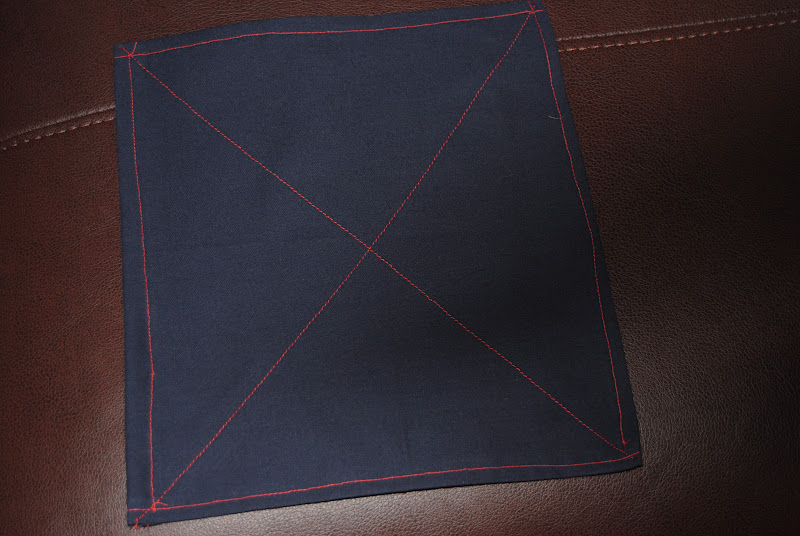
Then show the child how to match the edges so that you are folding on the coloured line.

Squares


Triangles
You can then do ones with several folds.
If you have an older child, you might even consider using this activity to introduce them to a cool iron and ironing board. We did this today and at 7, she was more than capable. My feeling is that as long as you can have them (the child) standing with both feet on the floor rather than on a stool, so they can reach the board (mine goes to a really low height) you can show them how to iron.

I just had to show you this as well. This is a child sized cheese or lemon/nutmeg grater. It's amazing what you can find when you look around. Thank you TKMaax!
Over the next few months as I begin to prepare for the Parent and Infant classes and my own Montessori journey I will bring you more reflections and share further ideas.
Monday, November 22, 2010
New Beginnings
It has been a very long time since I last posted anything on this blog. Things have changed in our life but Montessori still prevails.
On a schooling front, all three are back in various schools now for a variety of individual reasons, some of which were mine, many were theirs, however, one reason is that I decided to go back to school myself and this, in itself, is proving an adventure with many paths that are converging.
It's incredibly exciting but over the next year or three I shall be studying to become a midwife and working on a project with a team of Montessorians in Brighton to prepare a Montessori antenatal curriculum. This is to realise a vision that they and I have that Montessori education is less encased in the parameters set out by the word education and more a way of life.
As this blog has already demonstrated, there is so much of Montessori's learnings and observations that need to exist in the home in order for there to be continuity and security in a child's life if that Montessori education is the family choice. However, perhaps there is more still.
Montessori talks in her book "The Absorbent Mind" about the newborn having a mental life that must exist embryonically, therefore, if this is the case, how much do babies remember about their birth or life in the womb and what is the connection between babies who are perhaps upset in this existence womb side and their early life during the extrogestational period. It is easy to observe a baby earthside and take responsibility for their development and stimulation, but how many people, honestly and truly, take as much responsibility as to their birth experience from their baby's perspective? How many women, hand on heart, irrevocably trust their bodies and their babies the first time they have a baby? Well, the statistics are not in favour and I for one, was a number within those stats.
It is not just Montessori who speaks of this; similar writings on this subject can be found in work by Rudolph Steiner and Emi Pikler. I think we would be arrogant to say that we understand how life really starts and what external sources or choices are made, cosmically even, to define our destinies. If a child initiates birth, perhaps the spirit of the child initiates conception, why did that particular gamete reach that particular egg? All through life we have the opportunity to initiate events that may seem mysterious to us.
We trust our bodies to tell us when we are hungry, when we need to urinate or defecate, when we need to rest or drink water and we trust our hearts to beat every day. Amazingly, we put our trust into the organs that work these systems in our bodies, yet we don't trust our bodies to birth and put all our faith into technology and hospitals (92% of babies are currently born in hospital in the UK). Through doing this, are we setting up the perfect environments for our babies to be born? I could talk about this for hours and for fear of sounding like a homebirth radical with a disregard for hospital as being a safe place for babies to be born (which I am not), or an anti-c-section nutcase (which equally, I am not) I will not digress further.
So, the idea of Montessori style prenatal education is a logical beginning in my opinion. Perhaps the idea of the prepared prenatal period should bear as much relevance as the prepared environment?
So, I hope that this blog will become more active again over the next few months as we start to develop this programme. I hope that we can create and inspiring and helpful programme that will encourage more families to make the same conscious decisions they make postnatally, in the antenatal and maybe even conception period.
So please, bear with me and stick around.
Yours in the Montessori spirit x
On a schooling front, all three are back in various schools now for a variety of individual reasons, some of which were mine, many were theirs, however, one reason is that I decided to go back to school myself and this, in itself, is proving an adventure with many paths that are converging.
It's incredibly exciting but over the next year or three I shall be studying to become a midwife and working on a project with a team of Montessorians in Brighton to prepare a Montessori antenatal curriculum. This is to realise a vision that they and I have that Montessori education is less encased in the parameters set out by the word education and more a way of life.
As this blog has already demonstrated, there is so much of Montessori's learnings and observations that need to exist in the home in order for there to be continuity and security in a child's life if that Montessori education is the family choice. However, perhaps there is more still.
Montessori talks in her book "The Absorbent Mind" about the newborn having a mental life that must exist embryonically, therefore, if this is the case, how much do babies remember about their birth or life in the womb and what is the connection between babies who are perhaps upset in this existence womb side and their early life during the extrogestational period. It is easy to observe a baby earthside and take responsibility for their development and stimulation, but how many people, honestly and truly, take as much responsibility as to their birth experience from their baby's perspective? How many women, hand on heart, irrevocably trust their bodies and their babies the first time they have a baby? Well, the statistics are not in favour and I for one, was a number within those stats.
It is not just Montessori who speaks of this; similar writings on this subject can be found in work by Rudolph Steiner and Emi Pikler. I think we would be arrogant to say that we understand how life really starts and what external sources or choices are made, cosmically even, to define our destinies. If a child initiates birth, perhaps the spirit of the child initiates conception, why did that particular gamete reach that particular egg? All through life we have the opportunity to initiate events that may seem mysterious to us.
We trust our bodies to tell us when we are hungry, when we need to urinate or defecate, when we need to rest or drink water and we trust our hearts to beat every day. Amazingly, we put our trust into the organs that work these systems in our bodies, yet we don't trust our bodies to birth and put all our faith into technology and hospitals (92% of babies are currently born in hospital in the UK). Through doing this, are we setting up the perfect environments for our babies to be born? I could talk about this for hours and for fear of sounding like a homebirth radical with a disregard for hospital as being a safe place for babies to be born (which I am not), or an anti-c-section nutcase (which equally, I am not) I will not digress further.
So, the idea of Montessori style prenatal education is a logical beginning in my opinion. Perhaps the idea of the prepared prenatal period should bear as much relevance as the prepared environment?
So, I hope that this blog will become more active again over the next few months as we start to develop this programme. I hope that we can create and inspiring and helpful programme that will encourage more families to make the same conscious decisions they make postnatally, in the antenatal and maybe even conception period.
So please, bear with me and stick around.
Yours in the Montessori spirit x
Wednesday, May 6, 2009
Baby steps
Where are we now? Week five perhaps? I'm not sure. However, it's beginning to settle. We're finding a natural rhythm to our day and I'm even finding the odd pocket of time to do my own bits.
It's interesting to have the three of them at such different stages of their natural development. Master Beehive the elder is a bookish character, quite self motivated and with a love for maths and reading. He'll happily soak up various worksheets or projects, however, he hates to get anything "wrong" and finds it hard to inspire himself to do stuff outside what he's given to do. Master Beehive the younger, however, prefers to work with manipulatives. He's more tactile and a kinaesthetic learner. He likes to be actively doing things, so the montessori materials are coming in wonderfully here for helping him with his Th, H, T and U addition at the moment and animal classification.
Little Miss Beehive, on the other hand, loves to do the work, but being younger, needs more attention. She really could do with more time on the manipulatives, but needs me sat beside her.
I'm sure that time will help this division of my time.
Last night, much to Mr Beehive's horror, I sat and made a load of bead chains. LMB and I discovered a great Hobbycraft whilst the boys were at Spanish class and we bought several bags of coloured beads and some wire. We need to go back as my bead chains are only up to 8 beads so far, but there are 10 chains of each, so hopefully we'll move on to using these fairly soon. The History timeline.
 The History timeline.
 LMB learning to number values by using the addition strips from WHSmiths!!
Tomorrow we are off to the sea bird centre all being well, which ties in nicely with our animals topic and on Saturday LMB is going to make some gingerbread men. Next week we are hoping to go to the Botanic gardens for a class on "Plants we use" with a some folks from the Home Ed group.
Thursday, April 23, 2009
Hit the ground running!
Well, we're closing our first *official* week of home educating and I have to say, I feel we've really hit the ground running. The myth that home educated children miss out on socialising has been well and truly squashed, albeit, quite where my social life will fit in on this may depend on the appointment of a regular babysitter for an afternoon a week! They are currently (between them) doing swimming lessons, Spanish lessons, music classes, ballet and cub scouts!
There are many approaches to home ed from my understanding, but ours is a more traditional *school* approach and we're aiming to continue using some of the Montessori methods that we've learned in the last five years.
The room has been set up in a pretty prepared way with low shelving and areas for each curriculum subject (or the main ones at least)
 The lowest shelving has the more practical life type activities with mathematics on the top shelf of this unit.

There are dvds and cdroms of various things and a box of growing National Geographics and History magazines as we pick them up if they have interesting things in them.
 Our rugs for laying out work stations and the magazine rack holds their various workbooks for different things.
The arts and crafts stuff is all in the wicker baskets with language and physical geography on the top shelf - and our massive pine cones from California, that all arrived uninjured!
Obviously if we bought a whole raft of Montessori equipment I'd currently be teaching them out of cardboard boxes on a street corner somewhere, so our materials are a mix of bought ones and home made ones. I invested in sandpaper letters (as I don't have the time or patience to make them), but made a moveable alphabet (well it wasn't what I called it then!) when I was teaching in Newcastle many moons ago, all beautifully laminated etc, so.....that works! Our countries work extends to two decent wooden puzzles and then a great magnetic Tesco kit that has countries, capitals and flags - there isn't quite the control of error, but for Will, he doesn't need that quite so much, so he does it with an atlas instead.

This is normally the table we use to snack at, but today it's become the drying table for the start of our iron age diorama. The children decided they wanted to make an iron age village after our visit to Flag Fen when we were back in East Anglia a few weeks back, so we've begun to make round houses, a river and fort. This week we hope to visit the remains of an iron age fort on the outskirts of Edinburgh.

With Elementary age, they naturally need a table to work at, so this is it. Each child's got their own work journal that we're working through daily at the moment, when they get in the swing of it and get a little older, they'll be able to pace their own days and get through their timetables to suit by the end of a week, hopefully instilling some sense of responsiblity for getting things done.
 Books - lots of books - I need more shelves!
 So this is LMB doing number bonds to 5 and making patterns - she's been doing this all week and seems to be pretty engrossed.
 Master Beehive the younger doing some fraction reinforcement using a great game from the High Street.
 The diorama beginnings in close up and appalling photography.
We have lots of plans lined up such as an intergrated project week in October to present to their grandparents, visits to the zoo to research a chosen animal in depth and also a visit to the Royal Botanical gardens to attend a plant classification class. There's also golf and tennis on the horizon, trips to the Edinburgh dungeons, setting up email accounts and working da interweb as well as.....just living!!!
Thursday, March 12, 2009
Art Lessons
I just wanted to share this new blog that has been created by the Beehive's art teacher at the Montessori School. She promises to update this with lots of videos and how-to's so I am predicting we'll be taking many ideas from here for our art time.
www.leonasartclass.blogspot.com
Roll up your sleeves and enjoy!
www.leonasartclass.blogspot.com
Roll up your sleeves and enjoy!
Sunday, March 1, 2009
Education for Life and integrated projects
It's March - supposedly the first day of the new season. Unfortunately there isn't much sign of new life here just yet. No daffs or snowdrops pushing through, however, there is up to 8 inches of snow forecasted for tomorrow *sigh* which is not a good concept when we're expecting movers to start packing and they're driving in from NY State.
We've not officially started Home Edding yet, but Master Beehive the elder is entering a geography competition which requires him to do a project on planning a trip to the North Pole, so he's quite caught up in that right now and ... well, monkey see, monkey do, Mr Beehive the younger is keen to do a research project too, so has decided to do one on "Elictisity". He wanted to know how electricity worked and inspired by the integrated projects that the Middle School at the Montessori did this week, he wants to do similar. He made a list of 10 items in the home today that use electricity.
We'll probably go to the library this week sometime to get out some books on the topic and he has already learned to build a circuit with Daddy, so when we get to Edinburgh we'll just reinforce this by getting the electricity kit out again.
I am envisaging a lot of work of this nature, the boys choosing something that grabs their interest and then we incorporate other subjects within it. It's true to life education i think. Education that happens as a natural extension to curiosity of the world. We may have to be a little more specific with maths and english, particularly for Master Beehive the elder, primarily because I feel there are things that "ought" to be known in english and things that will come up in exams in the future in maths that, even if they are never used in daily life, are necessary if he wants to sit an exam or return to school at some point. His dad is an accountant, so I am definitely expecting some form of natural mathematical tendencies to show through in one of the children, but then saying that, they have me, the maths dud, as their mother, so it may balance itself out :-)
Master Beehive the elder is supposed to be in the school Spelling Bee this Monday (weather permitting of course). We've had a lot of fun looking at the origins of words and then breaking them down. This is more my cup of tea!! Hopefully he'll get the chance to give it a bash before we leave, but the snow is not in his favour right now.
Okay, back to my real cup of tea!
We've not officially started Home Edding yet, but Master Beehive the elder is entering a geography competition which requires him to do a project on planning a trip to the North Pole, so he's quite caught up in that right now and ... well, monkey see, monkey do, Mr Beehive the younger is keen to do a research project too, so has decided to do one on "Elictisity". He wanted to know how electricity worked and inspired by the integrated projects that the Middle School at the Montessori did this week, he wants to do similar. He made a list of 10 items in the home today that use electricity.
We'll probably go to the library this week sometime to get out some books on the topic and he has already learned to build a circuit with Daddy, so when we get to Edinburgh we'll just reinforce this by getting the electricity kit out again.
I am envisaging a lot of work of this nature, the boys choosing something that grabs their interest and then we incorporate other subjects within it. It's true to life education i think. Education that happens as a natural extension to curiosity of the world. We may have to be a little more specific with maths and english, particularly for Master Beehive the elder, primarily because I feel there are things that "ought" to be known in english and things that will come up in exams in the future in maths that, even if they are never used in daily life, are necessary if he wants to sit an exam or return to school at some point. His dad is an accountant, so I am definitely expecting some form of natural mathematical tendencies to show through in one of the children, but then saying that, they have me, the maths dud, as their mother, so it may balance itself out :-)
Master Beehive the elder is supposed to be in the school Spelling Bee this Monday (weather permitting of course). We've had a lot of fun looking at the origins of words and then breaking them down. This is more my cup of tea!! Hopefully he'll get the chance to give it a bash before we leave, but the snow is not in his favour right now.
Okay, back to my real cup of tea!
Friday, December 5, 2008
A change of direction
Yet again I have left this blog too long, everylife seems to have rudely gotten in the way!
Anyway, over the next few months this blog will probably start to become more proactive (hoorah!) as we are changing our journey in life at least for the short term.
Currently, as you know, we are living in the US and the children are attending a wonderful 0 -14 years AMI Montessori School, so this blog has been talking about how we maintain the Montessori principles and philosophies in the home, education aside. We have just found out however, we are moving again. This time the Crags of Bonnie Scotland are calling (well, strictly that's not true as we're going to Edinburgh and it's.......well, not so craggy!)
I have been looking into the transfer for the children in the hopes there is something they can attend that is following Montessori but to no avail, not for the boys at any rate. The wee miss is going to be attending a Montessori nursery in the afternoons but the boys are going to be staying home and we are going to home educate in Montessori style.
So the blog will now follow our journey as we venture into this area. Both boys are now elementary age so our curriculum will be within this plane of development. I am a trained state/public school teacher and naturally have those traditional teaching methods ingrained in my head, I am not Montessori trained (yet!) and so I will be learning new ways too.
To date all I have done is trawl through the types of Montessori equipment that I think I will really need and that are probably hard to make and the rest I will make or adapt or improvise as need arises.
I don't want to follow a rigid timetable, but do intend to follow a daily pattern or routine, just as Montessori would have done. The boys will be free to do whatever the work they need to do from their assignment book which I'll plan the week before and then we'll discuss any visits or outside activities on a Monday morning meeting that might need to be fitted in and take up space they were expecting to have to work in. I am still working through the early thoughts right now but the areas I wish to have daily are a quick mental math each day and then within the course of the week, handwriting, spelling and journalling. The rest of the week I hope to go more with the flow (hard for a traditional teacher, the lure of a text book and lesson planner are just too great).
I have chosen at this point to break down the areas of maths and language that I feel they probably should cover or know at this point and get these covered throughout the weeks using the tactile materials that Montessori made, history, geography, science, botany and zoology I intend to work into our "curriculum" more from a "go-see-expand" idea; we'll visit somewhere perhaps or use something poignant in the news and then expand the topics from that for the week, or we may use the five great lessons to inspire our direction.
Added into this equation is the Little Miss who will be with us in the mornings, so I may also incorporate some practical life, sensorial, maths and language based on her development too.
My current tool kit is looking quite plush and I'm feeling pretty inspired right now.
I bought much of the stuff from Montessori Outlet which sells the stuff at cheap as chips prices and it is pretty good quality too (not pure Nienhaus natch!) but their selection of what I really feel I need at Elementary level is limited, that said, I am envisaging that gradually as the mind works more abstractly the boys will use less materials anyway and will be able to immediately work out on paper.
Currently I have:
cursive sandpaper letters and sandpaper phonograms
a multiplication board
a division board
a power of two board
grammar symbols and advanced grammar symbols
tens board
I think for now, that will work for us. I am hoping to be able to make other resources as we go along.
There are a plethora of great sites that have printable Montessori resources that I will download and use.
One of my immediate issues is the need to learn to use the materials myself and all their developments otherwise Master Beehive the elder will be teaching me, which, actually isn't a bad thing as it'd reinforce it for him, but it makes it hard for me to use them for extension work if needs arise.
So, I hope you'll stay with us and follow the ups and downs we come across as we all learn new things from this.
Anyway, over the next few months this blog will probably start to become more proactive (hoorah!) as we are changing our journey in life at least for the short term.
Currently, as you know, we are living in the US and the children are attending a wonderful 0 -14 years AMI Montessori School, so this blog has been talking about how we maintain the Montessori principles and philosophies in the home, education aside. We have just found out however, we are moving again. This time the Crags of Bonnie Scotland are calling (well, strictly that's not true as we're going to Edinburgh and it's.......well, not so craggy!)
I have been looking into the transfer for the children in the hopes there is something they can attend that is following Montessori but to no avail, not for the boys at any rate. The wee miss is going to be attending a Montessori nursery in the afternoons but the boys are going to be staying home and we are going to home educate in Montessori style.
So the blog will now follow our journey as we venture into this area. Both boys are now elementary age so our curriculum will be within this plane of development. I am a trained state/public school teacher and naturally have those traditional teaching methods ingrained in my head, I am not Montessori trained (yet!) and so I will be learning new ways too.
To date all I have done is trawl through the types of Montessori equipment that I think I will really need and that are probably hard to make and the rest I will make or adapt or improvise as need arises.
I don't want to follow a rigid timetable, but do intend to follow a daily pattern or routine, just as Montessori would have done. The boys will be free to do whatever the work they need to do from their assignment book which I'll plan the week before and then we'll discuss any visits or outside activities on a Monday morning meeting that might need to be fitted in and take up space they were expecting to have to work in. I am still working through the early thoughts right now but the areas I wish to have daily are a quick mental math each day and then within the course of the week, handwriting, spelling and journalling. The rest of the week I hope to go more with the flow (hard for a traditional teacher, the lure of a text book and lesson planner are just too great).
I have chosen at this point to break down the areas of maths and language that I feel they probably should cover or know at this point and get these covered throughout the weeks using the tactile materials that Montessori made, history, geography, science, botany and zoology I intend to work into our "curriculum" more from a "go-see-expand" idea; we'll visit somewhere perhaps or use something poignant in the news and then expand the topics from that for the week, or we may use the five great lessons to inspire our direction.
Added into this equation is the Little Miss who will be with us in the mornings, so I may also incorporate some practical life, sensorial, maths and language based on her development too.
My current tool kit is looking quite plush and I'm feeling pretty inspired right now.
I bought much of the stuff from Montessori Outlet which sells the stuff at cheap as chips prices and it is pretty good quality too (not pure Nienhaus natch!) but their selection of what I really feel I need at Elementary level is limited, that said, I am envisaging that gradually as the mind works more abstractly the boys will use less materials anyway and will be able to immediately work out on paper.
Currently I have:
cursive sandpaper letters and sandpaper phonograms
a multiplication board
a division board
a power of two board
grammar symbols and advanced grammar symbols
tens board
I think for now, that will work for us. I am hoping to be able to make other resources as we go along.
There are a plethora of great sites that have printable Montessori resources that I will download and use.
One of my immediate issues is the need to learn to use the materials myself and all their developments otherwise Master Beehive the elder will be teaching me, which, actually isn't a bad thing as it'd reinforce it for him, but it makes it hard for me to use them for extension work if needs arise.
So, I hope you'll stay with us and follow the ups and downs we come across as we all learn new things from this.
Sunday, October 26, 2008
DVD
"A Parent's Guide" is a well worthy dvd to purchase if you don't know where to start. It is a great visual tool showing three families with their rooms set up and devoted to the child at their relevant age.
Sunday, September 14, 2008
Mealtimes
It has been brought to my attention that I have yet to make a blog entry that talks about foods and snacks in the Montessori environment. Coincedentally, this week at school has been a week where snack has been fore front of my mind.

Our school now has a nut free policy as well as the natural healthy eating policy. This hasn't been an issue in the past as there has been a rota for providing snacks from a pre-set list, however, this year, in the lower elementary classrooms, snacks are to be provided daily from home. Naturally, this is the year my "difficult eater" is in this environment, so providing nut free snacks that disguise any element of fruit or veg and maintain healthy eating status is my quest for this year.
Naturally, foods and snacks for any child need to be slow releasing energy. High sugar content, of course, releases a rush, and then the down side can be lethargy or lack of concentration.

My favourite book for snack ideas is Lunchboxes by Annabel Karmel.
Listed below I have shared ideas for snacks that are nut free and low sugar. There are also ideas for other school morning breakfasts and lunches. Please feel free to add to this via the comments as it would be great to share thoughts and ideas.
School Morning breakfasts (the theme is healthy and QUICK!!)
Oatmeal - always a favourite
Natural Yoghurt and honey
Poached or Boiled egg and wholemeal toast or muffin
Toaster waffles with fresh fruits
fruit salad with granola (you can make your own if you want nut free and just use rolled oats)
Breakfast bars - I will dig out a link to the recipe for this later
Banana (or any other fruit) smoothies
Snack ideas for school
Fruit
Veg
Hummus to dip veg in
Plain crackers
Hard boiled egg
Cheese cubes
Raisins or dried fruit (my kids love apple rings and mango pieces)
Dehydrated fruit - you can either do this yourself or buy all kinds of exotic fruits that have been deydrated. My middle child (the self assigned "vegandfruitaphobe" will happily consume these on the premise they "taste like candy"!!)
Bagel chips
Bagel halves
Pretzels
Mini pitas (with dips or spread)
Healthy O's (cereal without the added sugar - think cheerios without the crap!)
Yoghurt (I send in a little pot with natural yoghurt and honey on the top - half the price and half the sugar!)
Fruit purees/sauces
Dried banana chips
Healthy valley's oatmeal bars (there are no nuts in these as far as I am aware)
Tofu (Whole foods and trader joe's do lovely flavoured tofu that can be sliced)
Soy butter is a great, nut free alternative to peanut butter and can be a great dip
Obviously as with all these items, if there is a child with a nut allergy in the class, always check how severe, because even if an item doesn't have nuts in it, it may be made in a factory that produces nuts and this can sometimes be enough to set off an allergic reaction. Also, always ensure your child washes their hands after eating any nut product if they are going into school and into contact with children who may be allergic!
Lunch ideas:
We tend to use any of the following as the "outer"
tortilla flour wraps
Pita breads
Pita breads
Wholemeal bread
Bagels
Crackers
Fillings:
cheese
ham
cream cheese
roasted vegetables
egg and mayo (you can add corn and chives if your child isn't picky!!)
tuna fish, cucumber, mayo
Tomato and cheese
grated celery, mayo and grated cheese (my fav!!)
Other ideas:
mini muffin pizzas
pasta salads made with hidden veggie sauce (I will post a link for a recipe later)
mini potato skins with home made salsa
bean salad
crudities
homemade soups and oyster crackers - great way to get the reluctant veggie eater to eat some!!
noodles and homemade sauces
Occasionally as a treat my kids love pot stickers and shimu or veggie sushi (they would eat the regular raw fish sushi, but I have a feeling that nut allergies tend to go hand in hand with seafood allergies too.)
any leftovers that you know your child will eat !!!
I do encourage my children to pack their own lunchbags with my help and they make choices from the foods I have bought in for the purpose.
At school I know the children all eat together. In the primary programmes this is a beautiful occasion that is prepared by the children. All the tables are set for lunch with silver and glassware, a candle and the lights are dimmed and music is played. The lunchtime is a revered occasion that the children and teacher enjoy together.
At home, we manage to replicate that as often as we can. It is hard in a working family environment to all find time to eat together due to work schedules. In the Beehive we try, wherever possible to eat together, occasionally that may be me enjoying a cup of tea at the dinner table whilst the children eat if I am waiting for my husband to come in later from work on a Friday.
We set the table appropriately with silver and glassware and use china plates rather than plastic. The reason behind this is that children want their table to look nice and there is a reason to take care with things otherwise they will break. If you carry a plastic item, there is not the same need for care.
We use cloth napkins and jugs for water, milk or juice as often as possible. The only thing I don't tend to do at home is the candle, primarily because there is a side of me that is just damn forgetful and also, no matter what you are lead to believe, kids will behave differently at home than school, thus at school the candle is respected, at home......the respect somewhat forgotten!! *sigh*
I hope this has been of some help. Please feel free to add your own thoughts and comments.
Tuesday, February 12, 2008
Playroom
Still a work in progress here.
Now worked on the "home area"
We have added hooks for cups, pans etc and a clothes line as well as this gorgeous screen from Marmalade Trees on Etsy to create walls!


 I also bought this set of cubing for MB the younger's room to help organise his stash of stuff a little better. He is thrilled he now has a plant to care for too!
And finally I attempted some needlefelting this week - I am almost too ashamed to put it up here, but still, it relieved some stress for a while lol and hopefully I may get better!

This is my gnome who has a very badly proportioned body!!
 This is the "fall" picture.
Subscribe to:
Posts (Atom)